

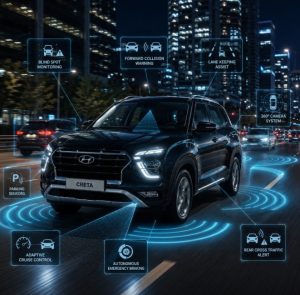
 Modern vehicles are no longer judged only by engine power, fuel efficiency, or design. Safety and security have become equally important, especially for urban drivers who navigate busy roads, unpredictable traffic, and rising concerns about vehicle theft. Hyundai has responded to these expectations by equipping the Creta with a wide range of smart sensor-based technologies designed to improve both passenger safety and vehicle protection.
The Hyundai Creta distinguishes itself in the compact SUV segment by combining convenience with intelligent security systems. At the center of many of these systems are smart sensors. These sensors continuously monitor the vehicle’s surroundings, driver behavior, and road conditions. They collect real-time data and help the vehicle react faster than human reflexes in many situations.
Smart sensors in the Hyundai Creta are not limited to one function. They support advanced driver assistance systems, theft prevention, collision avoidance, parking support, and overall driving awareness. Together, they create a more secure driving experience for both drivers and passengers.
Parking Assistance and Obstacle Detection
One of the most noticeable sensor-based features in the Hyundai Creta is the parking assistance system. Parking in tight urban spaces can be stressful, especially for new drivers. The Creta uses ultrasonic sensors placed around the vehicle to detect nearby obstacles. These sensors measure the distance between the SUV and surrounding objects. When the vehicle gets too close, the system sends visual and audio alerts to improve driver awareness.
This feature reduces the chances of minor collisions while parking. It also helps protect pedestrians, cyclists, and nearby vehicles from accidental contact. In busy city environments, these parking sensors provide practical everyday safety benefits.
Blind Spot Monitoring and Rear Awareness
Another major security advantage comes from the Creta’s rearview and surround awareness systems. Smart sensors work alongside cameras to improve visibility around the vehicle. Blind spots remain a major cause of lane-change accidents. Hyundai addresses this problem by using radar and proximity sensors that monitor areas the driver may not easily see.
When a nearby vehicle enters the blind spot, the system alerts the driver via dashboard indicators or warning sounds. This extra layer of awareness helps minimize side-impact crashes on busy roads.
Collision Prevention Technologies
The Hyundai Creta also uses smart sensors for collision prevention technologies. Advanced variants are equipped with Hyundai SmartSense, a suite of driver assistance features that rely heavily on radar sensors, cameras, and electronic control systems.
Forward collision warning is one example. Sensors constantly scan the road ahead to detect vehicles or obstacles. If the system senses a possible collision, it warns the driver immediately. If the driver fails to respond in time, automatic emergency braking may activate to reduce impact severity or avoid the collision entirely.
This feature proves especially beneficial in heavy traffic situations where vehicles frequently stop without warning. While human response times may differ depending on attention and fatigue, sensor-driven systems continuously monitor the road and remain active at all times.
Lane Keeping and Highway Safety
Lane keeping assistance relies on advanced cameras and sensor technology to improve driving stability. It tracks road lane markings and can recognize when the vehicle begins to move out of its lane without the driver signaling or intending to do so. If necessary, the system provides steering corrections or driver alerts.
This feature improves highway safety, particularly during long drives where fatigue can affect concentration. While it does not replace attentive driving, it acts as an additional layer of protection.
Stability Control and Driving Support
Smart sensors also contribute to driver monitoring and stability control systems. Electronic Stability Control (ESC) uses wheel-speed sensors and steering-angle sensors to detect loss of traction. If the system senses instability during cornering or on slippery roads, it automatically adjusts engine power and braking force to maintain vehicle control.
This is particularly important during heavy rain or sudden evasive maneuvers. SUVs naturally sit higher than sedans, so maintaining balance during sharp turns is critical for safety.
Theft Protection and Smart Key Security
Another important aspect of Hyundai Creta’s security setup is theft protection. Modern vehicles increasingly rely on electronic systems rather than solely on mechanical security. Smart key sensors and immobilizer technology help prevent unauthorized vehicle access.
The Creta’s smart key system uses encrypted communication between the key fob and the vehicle. The engine will start only when the correct authenticated signal is detected. This reduces the risk of hot-wiring or unauthorized ignition attempts.
In some variants, connected car technology further strengthens security. Hyundai’s connected systems allow owners to monitor vehicle status remotely through mobile applications. Drivers can track vehicle location, receive alerts about unauthorized access, and even access emergency support features.
Passenger Safety and Airbag Sensors
Sensors also play a role in occupant safety inside the vehicle. Airbag deployment systems rely on crash sensors to determine impact severity and trigger airbags at the right moment. Seatbelt reminder systems use occupancy sensors to detect whether passengers are properly secured.
These systems work within milliseconds during an accident. Proper timing is critical because delayed airbag deployment can reduce effectiveness, while unnecessary deployment can cause injury. Smart sensors help maintain that balance.
The Growing Importance of Smart Sensors
The growing role of sensors in vehicles also reflects broader automotive industry trends. Consumers now expect vehicles to assist with decision-making and hazard detection. Features that were once available only in luxury vehicles are now becoming standard in compact SUVs like the Hyundai Creta.
However, it is important to understand that smart sensors are support systems, not replacements for responsible driving. Drivers must remain alert, follow traffic rules, and properly maintain vehicle systems. Dirty sensors, damaged cameras, or neglected maintenance can reduce system accuracy.
Hyundai’s approach with the Creta shows how technology can improve road safety without making driving overly complicated. Most sensor-based features operate quietly in the background and intervene only when necessary. This creates a driving experience that feels natural while still offering strong protection.
Conclusion
As automotive technology continues to evolve, smart sensors will likely become even more advanced. Future systems may include improved predictive analytics, better pedestrian detection, and enhanced vehicle-to-vehicle communication. The Hyundai Creta already demonstrates how these technologies can be integrated into everyday driving in a practical and accessible way.
In the end, the role of smart sensors in Hyundai Creta security features goes beyond convenience. These systems help reduce accidents, improve driver awareness, strengthen theft protection, and support passenger safety. For drivers seeking a compact SUV that combines modern technology with practical security features, the Creta offers a strong example of how intelligent safety systems are shaping the future of driving.