

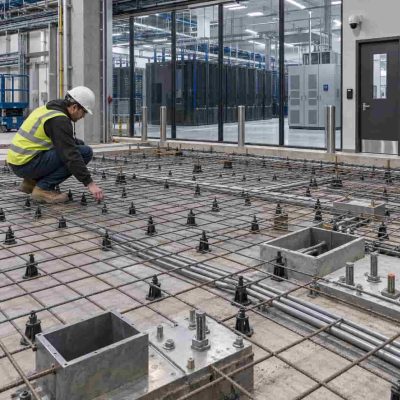
 Secure technology facilities depend on more than digital defenses. Data centers, network operations centers, telecommunications buildings, research laboratories, and equipment hubs also require physical structures that can protect sensitive systems from environmental conditions, unauthorized access, accidental impact, and heavy operational demands.
Reinforcing mesh, commonly known as reo mesh, plays an important role in constructing these facilities.
Although RWAP reo mesh is only one part of a larger security strategy, using it correctly can improve the strength, reliability, and serviceability of buildings that support essential technology.
Strengthening Concrete Floors
Technology facilities frequently contain heavy equipment. Server racks, battery banks, cooling units, electrical switchgear, backup power systems, and cable infrastructure can place concentrated loads on concrete floors. When a slab bends under a load, tensile stresses may develop and lead to cracking. Reo mesh helps distribute these stresses across the slab and limits crack width.
The required mesh type and placement depend on the slab thickness, support conditions, equipment weight, joint arrangement, and expected traffic. An engineer may specify different reinforcement for a ground-supported slab than for a suspended floor.
Properly reinforced floors provide a stable surface for sensitive equipment. They also help maintain alignment between cabinets, raised-floor systems, containment structures, and cooling components.
Controlling Cracks Around Sensitive Systems
Cracking is not only a cosmetic concern in a technology facility. Wide or uncontrolled cracks can allow water, dust, or contaminants into protected areas. Cracks can also affect floor finishes, interfere with equipment positioning, or indicate movement that requires investigation.
Reo mesh helps control the distribution and width of shrinkage and temperature-related cracking. As concrete dries, heats, and cools, it naturally experiences changes in volume. The steel mesh resists some of this movement and encourages smaller, more evenly distributed cracks.
Reinforcement cannot prevent every crack. Concrete mix design, joint placement, subgrade preparation, curing, slab dimensions, and environmental conditions also influence cracking. Reo mesh is most effective when it is incorporated into a complete concrete design rather than treated as a substitute for proper construction practices.
Supporting Secure Concrete Walls
Physical security often begins with the building envelope. You may use reinforced concrete walls around equipment rooms, control centers, storage areas, or other restricted spaces.
Reo mesh can reinforce both horizontal and vertical directions. This arrangement helps the wall resist forces created by shrinkage, temperature changes, wind, soil pressure, or accidental impact. In some applications, mesh may be installed in more than one layer to support thicker walls or higher design loads.
Concrete walls with appropriately designed reinforcement can also make unauthorized physical entry more difficult than lightweight partitions. However, wall strength alone does not create a secure room. Doors, frames, locks, windows, roof connections, service openings, surveillance, and access-control systems must provide comparable protection.
Improving the Performance of Foundations
Reliable technology operations depend on stable foundations. Excessive settlement or movement can damage equipment, affect cable connections, disturb cooling systems, or create problems with precisely aligned infrastructure.
Reo mesh may be used in foundation slabs, footings, equipment pads, and other concrete elements. It helps control tensile stresses and can improve concrete integrity when loads are distributed across the foundation.
Foundation requirements must be based on site-specific conditions. Soil strength, groundwater, flood risk, seismic activity, and the building’s weight all influence the design. A geotechnical investigation and structural analysis are therefore essential before selecting the reinforcement.
For facilities with heavy generators, transformers, or cooling equipment, you may need separately designed concrete pads. These pads must support static loads as well as vibration and operating forces.
Protecting Underground Services
Technology facilities rely on extensive networks of electrical cables, fiber-optic lines, drainage systems, fuel pipes, and cooling connections. Some of these services may run through underground trenches, ducts, or concrete-encased routes.
Reo mesh can reinforce the concrete surrounding service channels and utility structures. This helps the concrete manage loads from the ground, nearby vehicles, equipment, or maintenance activity.
Reinforced covers and enclosures can also protect critical connections. Access points must still be designed so authorized workers can inspect, repair, or replace services without damaging the surrounding structure.
Coordination is especially important in these areas. Unplanned cutting or drilling through reinforced concrete may damage the mesh or other structural reinforcement. Service routes, penetrations, and access openings should therefore be incorporated into the design before construction begins.
Supporting Fire and Environmental Protection
Steel mesh is typically encased in concrete, which provides some protection from heat and environmental exposure. Reinforced concrete construction may form part of a facility’s fire-rated walls, floors, and equipment enclosures.
The required fire resistance depends on the building code, occupancy, system layout, and risk assessment. Adequate concrete cover over the mesh helps protect the steel and allows the assembly to perform as designed.
Moisture exposure must also be considered. Water entering through damaged concrete can eventually contribute to steel corrosion. As corrosion progresses, the expanding products can crack or dislodge the surrounding concrete. Durable concrete, adequate cover, controlled joints, drainage, waterproofing, and regular maintenance all help reduce this risk.
Maintaining Quality During Installation
Even a well-designed reinforcement system can perform poorly if installed incorrectly. Reo mesh must be the correct grade, wire size, sheet dimensions, and spacing specified in the construction documents.
Support it on suitable chairs or spacers so it stays at the intended depth within the concrete. Mesh placed directly on the ground and lifted during pouring may not remain in the correct position. Overlaps, edge distances, penetrations, and connections must also follow the approved design.
Before concrete placement, inspections can confirm that the reinforcement is secure and that conduits, anchors, embedded items, and openings are correctly located. This reduces the risk of later cutting, patching, or rework near sensitive structural areas.
Building Security From the Structure Up
Secure technology facilities require multiple layers of protection. Cybersecurity systems, surveillance, access controls, fire suppression, backup power, and operational procedures are all essential. The building itself must provide a dependable platform for these systems.
Reo mesh contributes by strengthening concrete floors, controlling cracks, reinforcing walls, supporting foundations, and protecting service infrastructure. Its success depends on engineering, correct placement, high-quality concrete, and coordination with the facility’s operational requirements.
When these elements are planned together, reo mesh helps create a durable physical environment in which critical technology can operate securely and reliably.